



8 min read · Telecom CTO Briefing · Netz Consulting Engineering Team
Quick answer: Mobile operators reduce network OPEX fastest by verifying what they already paid for. An independent, third-party technical audit of new site rollouts, combined with vendor-agnostic managed services, removes the rework, repeat site visits, and unnecessary upgrades that quietly inflate operating budgets. Netz Consulting delivers both, with no hardware to sell.
Ask any operator CTO what dominates the 2026 board agenda and the answer is rarely a new technology. It is cost. Revenue growth is flat in most markets, spectrum and energy bills keep rising, and every rollout program is under pressure to prove its return.
The uncomfortable truth is that a large share of avoidable OPEX is created during rollout itself, then paid for every month after go-live. This briefing explains where that money leaks and how an audit-first approach stops it.
Key Takeaways for Telecom Executives
- OPEX efficiency is now the top business objective for operators investing in network automation and AI.
- Global telecom capex is tightening, so every deployed site must perform from day one.
- Rollout defects, misconfiguration, and vendor self-certification create recurring OPEX that rarely shows up in the project budget.
- Independent third-party audits and drive testing catch these issues before acceptance, when fixing them is cheapest.
- Vendor-agnostic managed services keep the gains in place after go-live.
Why Is OPEX the Top Priority for Telecom CTOs in 2026?
Because the money for growth is shrinking while networks keep getting more complex. In its 2026 network transformation survey, GSMA Intelligence reports that 85% of operators name OPEX efficiency as a priority objective for deploying AI in their networks. At the same time, Dell’Oro expects worldwide telecom capex to fall by roughly 2% in 2026, according to TelecomLead.
85%
of operators name OPEX efficiency a priority goal for network AI
-2%
forecast decline in worldwide telecom capex in 2026
Day 1
is when every new site now has to start paying back
Less capex means fewer chances to fix problems with new equipment. Operators now need the sites, links, and parameters they already deployed to deliver full value, and they need proof that they do.
Where Does Hidden OPEX Come From in a Network Rollout?
Hidden OPEX is any recurring cost created by a deployment issue that was never caught. It does not appear on the rollout invoice. It appears later, as field visits, trouble tickets, churn, and emergency upgrades.
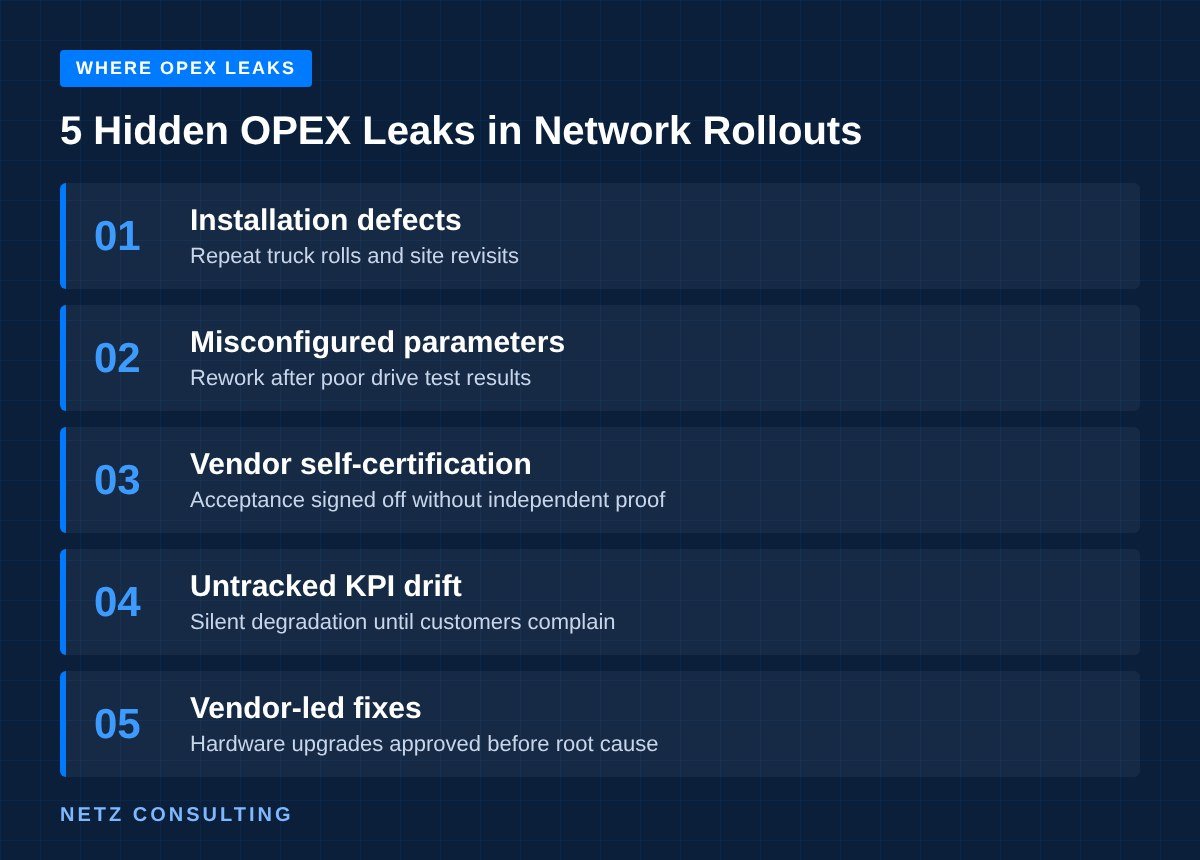
- Installation defects. Loose connectors, poor grounding, wrong antenna tilt or azimuth, and weak cabling lead to repeat truck rolls and site revisits for years.
- Misconfigured parameters. Neighbor lists, handover settings, and power parameters copied from templates create dropped calls and congestion that teams chase one ticket at a time.
- Vendor self-certification. When the party that installed the site also signs its acceptance, defects are documented as closed long before they are fixed.
- Untracked KPI drift. Without continuous KPI and KQI monitoring, performance degrades silently until customers complain or leave.
- Vendor-led fixes. When degradation is finally noticed, the default recommendation is often new hardware, approved before the real root cause is confirmed.
“The cheapest defect to fix is the one you catch before acceptance. After go-live, you pay for it every month.”
Khurrum Pervez, CEO, Netz Consulting
What Is a Third-Party Telecom Technical Audit?
A third-party telecom technical audit is an independent engineering review of how a network or rollout was actually built and configured, compared against design, vendor specifications, and operator KPIs. It is performed by a firm with no equipment to sell and no installation work to defend.
A complete audit typically covers:
- Physical installation: antennas, feeders, grounding, power, and cabinet build quality
- Configuration: parameters, neighbor relations, and transport settings against design
- Drive testing: real coverage, throughput, and call quality in the field
- Action plan: corrective actions ranked by cost impact
The value comes from independence. An auditor who is not paid to install or upgrade can tell you what is wrong, what it costs you, and what you do not need to buy.
How Does Netz Consulting Help Operators Cut OPEX?
Netz Consulting is a vendor-independent telecom engineering consultancy with teams across Botswana, Germany, South Africa, and Pakistan, and project delivery across Africa, Europe, and Asia. Our work is built around one principle: optimize and verify before you replace.
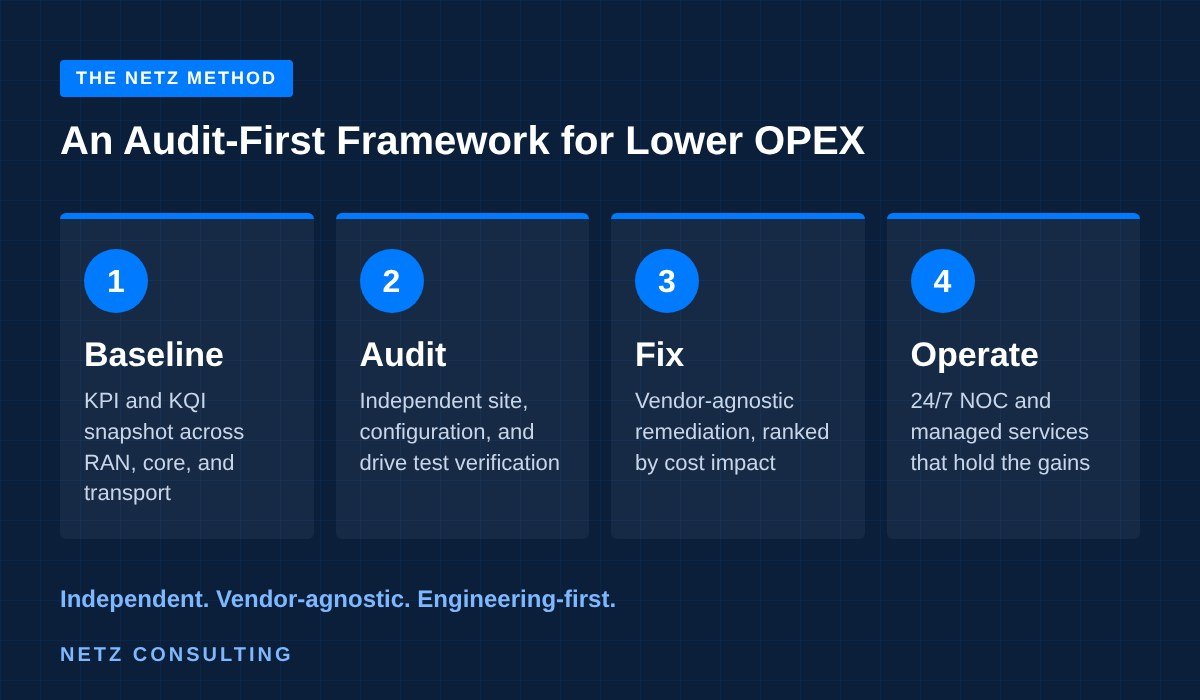
01
Independent Rollout and Installation Audits
We verify new-site configuration and physical installation before acceptance, so defects are corrected on the vendor’s time and budget, not yours.
02
Drive Testing and RF Optimization
Our engineers measure real voice and data performance in the field, then tune RF and parameters to close coverage and quality gaps without adding sites or hardware.
03
Vendor-Agnostic Managed Services and 24/7 NOC
After remediation, our managed services and round-the-clock NOC keep multi-vendor RAN, CS/PS core, and IP networks stable, so the savings hold month after month.
04
KPI Intelligence with Netzsta
Netzsta, our in-house telecom KPI intelligence engine, maps KPIs to KQIs and flags drift early, so your team acts on data instead of complaints.
For operators in Africa and Asia facing site theft and vandalism, our CRATUS theft-resistant cabinets add another OPEX lever, with zero theft recorded across 9,000 deployed telecom sites.
Planning a rollout this year? Get an independent view before sign-off.
Audit-First vs. Vendor-Led: How the Two Approaches Compare
| Decision Area | Vendor-Led Approach | Audit-First Approach with Netz |
|---|---|---|
| Site acceptance | Self-certified by the installer | Independently verified before sign-off |
| Performance issues | Solved with new hardware | Root cause fixed through configuration and RF |
| Vendor dependency | Grows with every upgrade | Reduced through multi-vendor expertise |
| KPI visibility | Periodic vendor reports | Continuous KPI and KQI monitoring |
| OPEX trend | Rises after go-live | Controlled and measurable |
CTO Checklist: 5 Questions Before Your Next Rollout Sign-Off
- Who verified the installation, and do they have any stake in the result?
- Do we have drive test data that matches the design targets for every new cluster?
- How many repeat site visits did our last rollout generate in its first six months?
- Which upgrade requests in our budget have a confirmed root cause?
- Can we see KPI and KQI drift across all vendors in one place, today?
If any answer is unclear, your network is likely carrying OPEX it does not need.
DIRECT LINE TO LEADERSHIP
Talk Directly with Our CEO
Book a call with Khurrum Pervez, CEO of Netz Consulting. Engineer to engineer, no sales script. Bring your rollout plan or your toughest KPI problem and leave with a clear view of where your OPEX is going.
Frequently Asked Questions
How can mobile operators reduce network OPEX without new hardware?
Start with an independent audit of existing sites and configuration, fix root causes through parameter and RF optimization, and move day-to-day operations to vendor-agnostic managed services with continuous KPI monitoring.
What does a telecom rollout audit include?
A rollout audit checks physical installation quality, site configuration and parameters, and real-world performance through drive testing, then delivers a ranked list of corrective actions before final acceptance.
Why should the auditor be independent from the equipment vendor?
An independent auditor has no hardware to sell and no installation work to defend, so findings focus on what the operator actually needs, not on what generates the next purchase order.
Does Netz Consulting work with multi-vendor networks?
Yes. Netz Consulting is vendor-agnostic and supports multi-vendor RAN, CS/PS core, and IP transport environments for operators across Africa, Europe, and Asia.
How do I speak with Netz Consulting leadership?
You can book a call directly with CEO Khurrum Pervez through the Netz Consulting contact page.
Related reading: How Independent Telecom Audits Improve Network Performance | Stop Paying for Upgrades Your Network Does Not Need
