



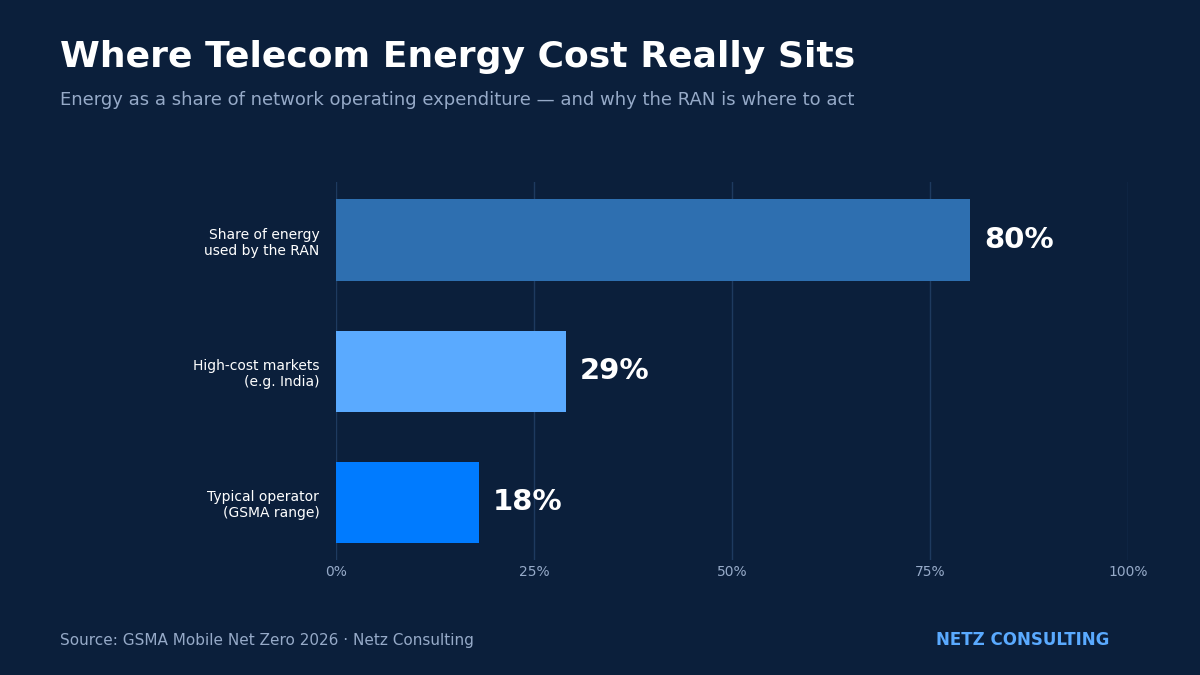
Ask a mobile operator’s finance team what is quietly eating the budget, and energy is now near the top of the list. Across the industry, electricity has climbed to roughly 15–20% of network operating costs — and in some markets it is closer to 30%. For a CTO, that turns a background utility bill into a board-level number.
The instinct is to wait for the next hardware refresh to fix it. But most of the savings are already sitting in the network you own today — if you know where to look. Here is how to cut telecom network energy costs without a hardware refresh.
Why network energy became a board-level number
Two things happened at once. Energy prices rose, and networks kept getting bigger — more sites, more spectrum, more antennas per tower. Even as operators improved efficiency per gigabyte by around 15% a year, total electricity consumption kept climbing because traffic and densification grew faster.
According to GSMA Mobile Net Zero research, energy accounts for roughly 15–20% of a typical operator’s operating expenditure, and in higher-cost markets it can reach nearly 30%. The most important detail for planning: about 80% of that energy is consumed by the radio access network (RAN). That is where the money is — and where the savings are.
The hardware-refresh trap
When energy costs spike, the default advice from equipment vendors is predictable: upgrade to the newest, more efficient hardware. Sometimes that is the right call. Often it is not.
A full swap-out is slow, capital-heavy, and defers savings for years while procurement and rollout run their course. It also assumes the bottleneck is the hardware itself — when in many networks the bigger issue is that existing energy-saving capabilities were never switched on or properly tuned. And a vendor’s roadmap is built to sell the vendor’s gear, not to squeeze the most out of the equipment you already have.
What actually cuts network energy — no new hardware required
1. Turn on the power features you already paid for
Modern RAN software ships with AI- and ML-driven energy features — deep sleep, carrier and cell shutdown during low traffic, and power-efficiency scheduling. Many operators have them available but not fully activated. Where they are switched on and tuned to real traffic, published results are striking: selected 5G sites have reported around 33% daily power reduction and up to 70% savings during off-peak hours, with no drop in user experience.
2. Optimize configuration and parameters, not just equipment
Traditional energy-saving settings often run on fixed time windows. That leaves capacity powered up when demand is low and can hold cells in a higher state than traffic requires. Tuning sleep thresholds and RF parameters to actual, measured traffic patterns — site by site — recovers energy that blanket schedules leave on the table. This is the core of independent network engineering and optimization, and it costs configuration time, not new capex.
3. Put the RAN first
If 80% of network energy sits in the RAN, that is where effort should concentrate. Chasing efficiency in the core or in facilities matters, but it moves a much smaller number. Prioritizing radio-side savings is simply where the leverage is.
4. Measure what matters: energy per gigabyte
Total electricity spend hides the real story. The metric that exposes waste is energy intensity — kWh per GB carried. Tracking it by site and by cell turns energy from a lump-sum bill into an operational KPI you can act on. This is exactly where data analytics and KPI intelligence earn their keep, surfacing the sites and hours where savings are largest before you touch a single parameter.
Why vendor independence changes the math
Here is the uncomfortable part. A vendor-led energy assessment has a built-in bias: the recommendation tends to end at a purchase order. An independent partner has no hardware to sell, so the analysis stays focused on the network itself — across every vendor in your estate, not just one.
That vendor-agnostic view is what finds the savings hiding in plain sight: features left off, parameters left at defaults, multi-vendor sites where nobody owns the full picture. It is the difference between being sold an upgrade and being shown where your existing network is leaking money.
A practical first step
You do not need a transformation program to start. A focused, independent energy audit will baseline your kWh per GB, check which power-saving features are active and correctly tuned, and quantify the savings available from configuration alone — before any capex conversation. From there, optimization and ongoing managed services keep the gains from drifting back.
An independent telecom technical audit is the fastest way to see how much of your energy bill is fixable without buying anything new.
Frequently asked questions
How much can operators realistically save without new hardware?
It varies by network, but the potential is meaningful. Where existing RAN power features are switched on and tuned to real traffic, operators have reported roughly 33% daily power reduction at selected sites and up to 70% during off-peak hours. Even a portion of that, applied across a large estate, is a material line-item change.
Will energy-saving features hurt network quality?
Not when they are tuned properly. The published gains above were achieved with no degradation in user experience. The risk comes from blanket, untuned settings — which is exactly why measurement and independent, site-level tuning matter.
Where should we start?
Start with the RAN and with data. Baseline your energy per gigabyte, confirm which power-saving features are actually active, and run an independent audit to quantify the configuration-only savings before committing capital.
How is this different from what our vendor offers?
A vendor optimizes within its own equipment and has an incentive to sell more of it. An independent, vendor-agnostic partner looks across your whole multi-vendor network with one goal: lower cost and better performance from what you already run.
Ready to see how much of your network energy bill is fixable without a refresh? Talk to Netz Consulting about an independent energy and optimization audit.
